PROJECTS
Here are some of the projects from my academics.
Click on the following sections to Expand.
Simulation of Fermi Hubbard Model Using Scalable Quantum Circuit
Abhinaba Pahari
Supervisor: Prof. Sonjoy Majumder, Department of Physics, IIT Kharagpur
Introduction
Simulation of many-body systems is a key area of interest in Condensed Matter and Atomic, Molecular Physics. Quantum computers, operating on the principles of quantum mechanics, are powerful tools for such simulations. The Fermi Hubbard Model is a strongly correlated electron system describing phenomena like phase transitions, magnetic ordering, and superconductivity.
Role of Quantum Computers
Classical computers struggle to handle the exponential growth of state space with particle count. For example, a 50-particle system requires around 1015 coefficients. Quantum computers naturally address this challenge using qubits, which can represent superposed states and inherently encode all possible configurations.
Fermi Hubbard Model
The model describes electrons hopping between lattice sites and interacting when occupying the same site. The Hamiltonian consists of:
- Hopping Term (kinetic energy)
- Self-Interaction Term (potential energy)
- Chemical Potential Term (optional for fixed particle numbers)
Jordan-Wigner Mapping
To simulate quantum systems on quantum computers, the system's state and operators are transformed into qubit space. For a 3-site, 1-dimensional Hubbard model, this requires 6 qubits.
Scalable Quantum Circuit
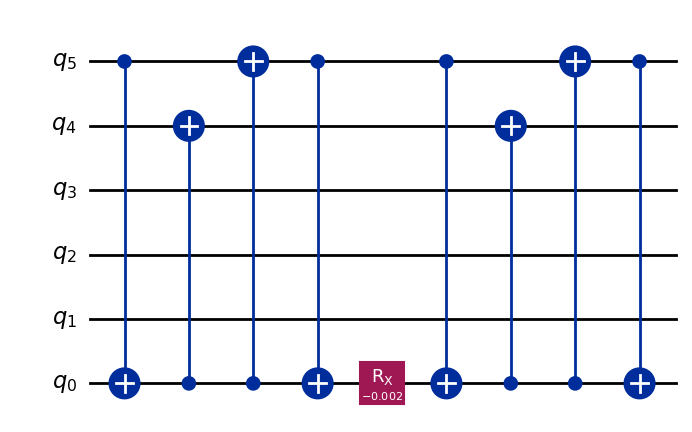
A scalable circuit allows constructing (n+1)-qubit systems by extending n-qubit circuits with additional gates. This approach is implementable on low-connectivity hardware like IBMQX2 using 1-qubit rotation gates and minimally connected CNOT gates.
Techniques Used
- Time Evolution: Trotter-Suzuki decomposition for approximating operator exponentials.
- Ground State Finding: Variational Quantum Eigensolver (VQE) and Exact Diagonalization. VQE uses the TwoLocal Ansatz for optimal results.
Applications and Results
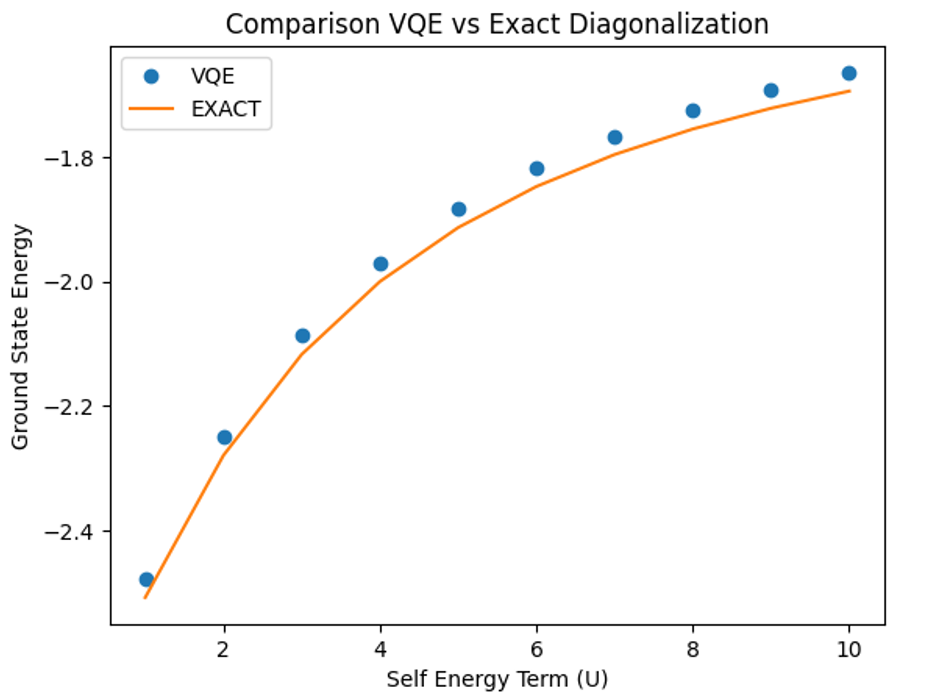
Using IBM's Qiskit framework, the Hamiltonian for a 3-site chain was mapped to qubits, and simulations were performed. Results demonstrated that VQE energy values closely matched exact values, validating the scalability and accuracy of the approach.
Conclusion and Future Work
The project successfully demonstrated scalable quantum circuits for simulating the Fermi Hubbard Model. Future goals include:
- Implementing Imaginary Time Evolution for ground state finding.
- Extending the model to complex lattices (e.g., triangular, honeycomb).
- Simulating the Bose Hubbard Model.
Acknowledgments
Special thanks to Prof. Sonjoy Majumder for his guidance and Mr. Sabyasachi Chakraborty for his support.
References
- IBM Qiskit
- Scalable quantum circuits for exponential of Pauli strings and Hamiltonian simulations - R. S. Sarkar et al.
- Elementary Introduction to Hubbard Model - A. Georges et al.
Wigner Description in Quantum Optics and its Application in Two-Mode Entanglement
Abhinaba Pahari
Supervisor : Dr. Tamoghna Das, Assistant Professor, IIT Kharagpur
Abstract
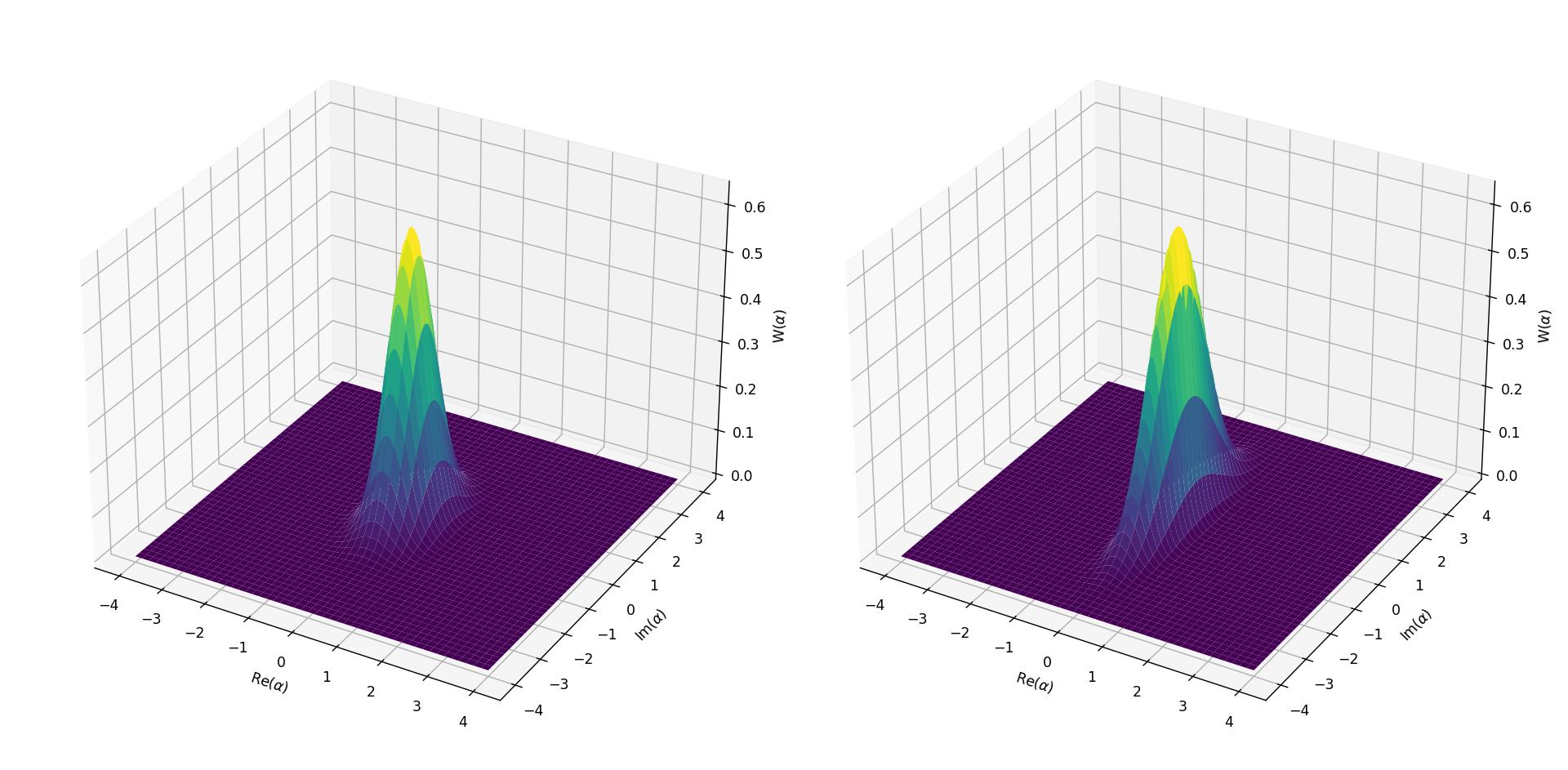
This work delves into the Wigner function's role in quantum optics, emphasizing its importance in describing continuous variable quantum states. Topics include coherent states, squeezed states, and photon-added states, along with their applications in two-mode entanglement analysis using phase-space representations.
Acknowledgement
I express my gratitude to Dr. Tamoghna Das for his constant guidance and to Mr. Abinash Kar for his support throughout this research.
Introduction
Quantum optics provides a platform to study the fundamental properties of light in terms of its quantum mechanical behavior. States like coherent and squeezed states form the foundation for quantum information protocols. This report explores the Wigner function, a quasi-probability distribution, as a tool for analyzing such quantum states.
Mathematics of Quantum States
The fundamental operators in quantum optics are the creation \(a^\dagger\) and annihilation \(a\) operators, obeying the commutation relation:
\[ [a, a^\dagger] = 1 \]
Key Quantum States:
- Fock State: \( |n\rangle \) is an eigenstate of the number operator \(n = a^\dagger a\).
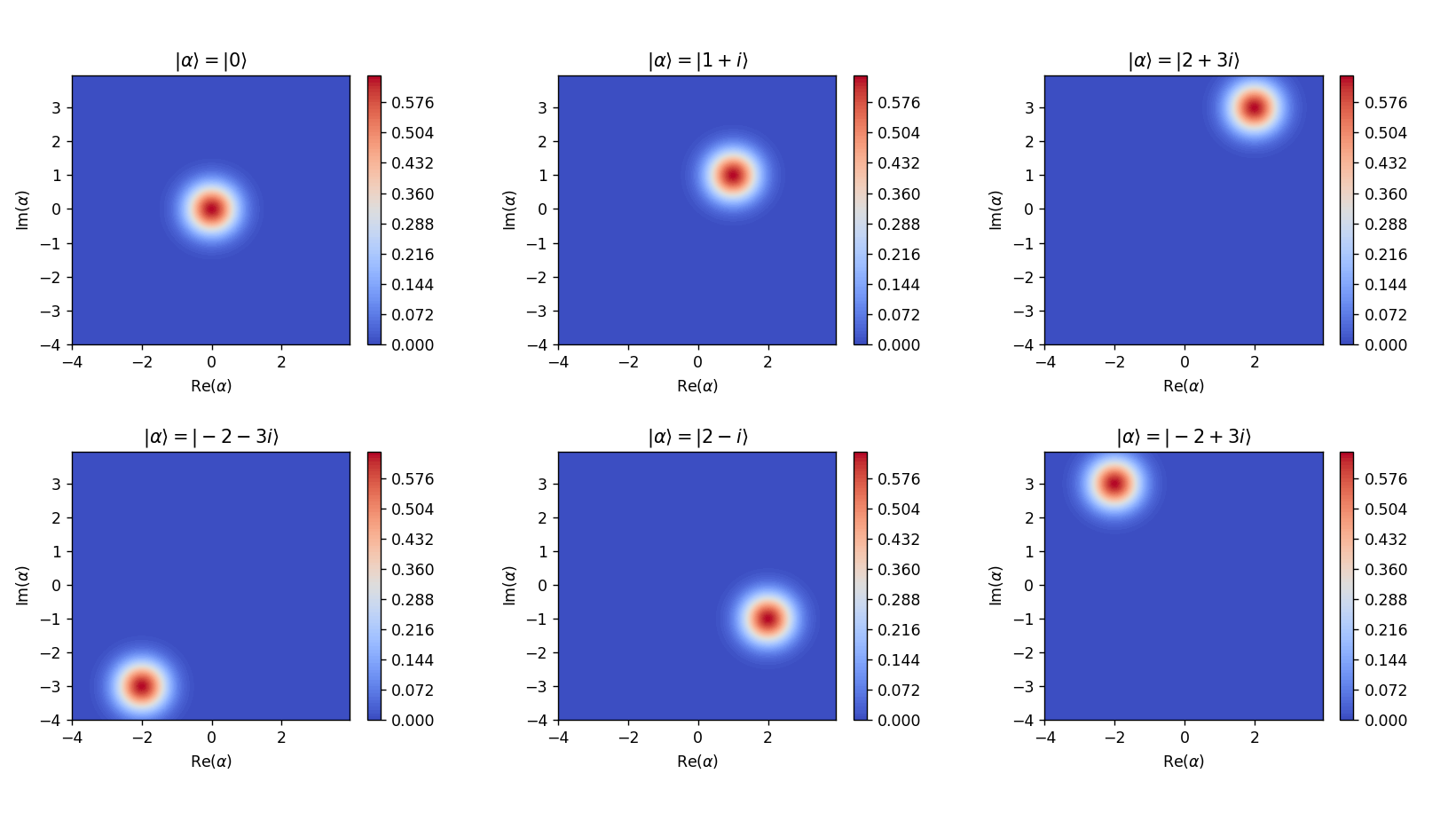
- Coherent State: Defined as \( |\alpha\rangle \) with \( a|\alpha\rangle = \alpha|\alpha\rangle \), it minimizes the uncertainty relation.
- Squeezed State: \( |r\rangle \) is obtained by applying the squeezing operator \( S(r) = \exp\left(\frac{r}{2}(a^2 - a^{\dagger 2})\right) \) to the vacuum state.
Wigner Function:
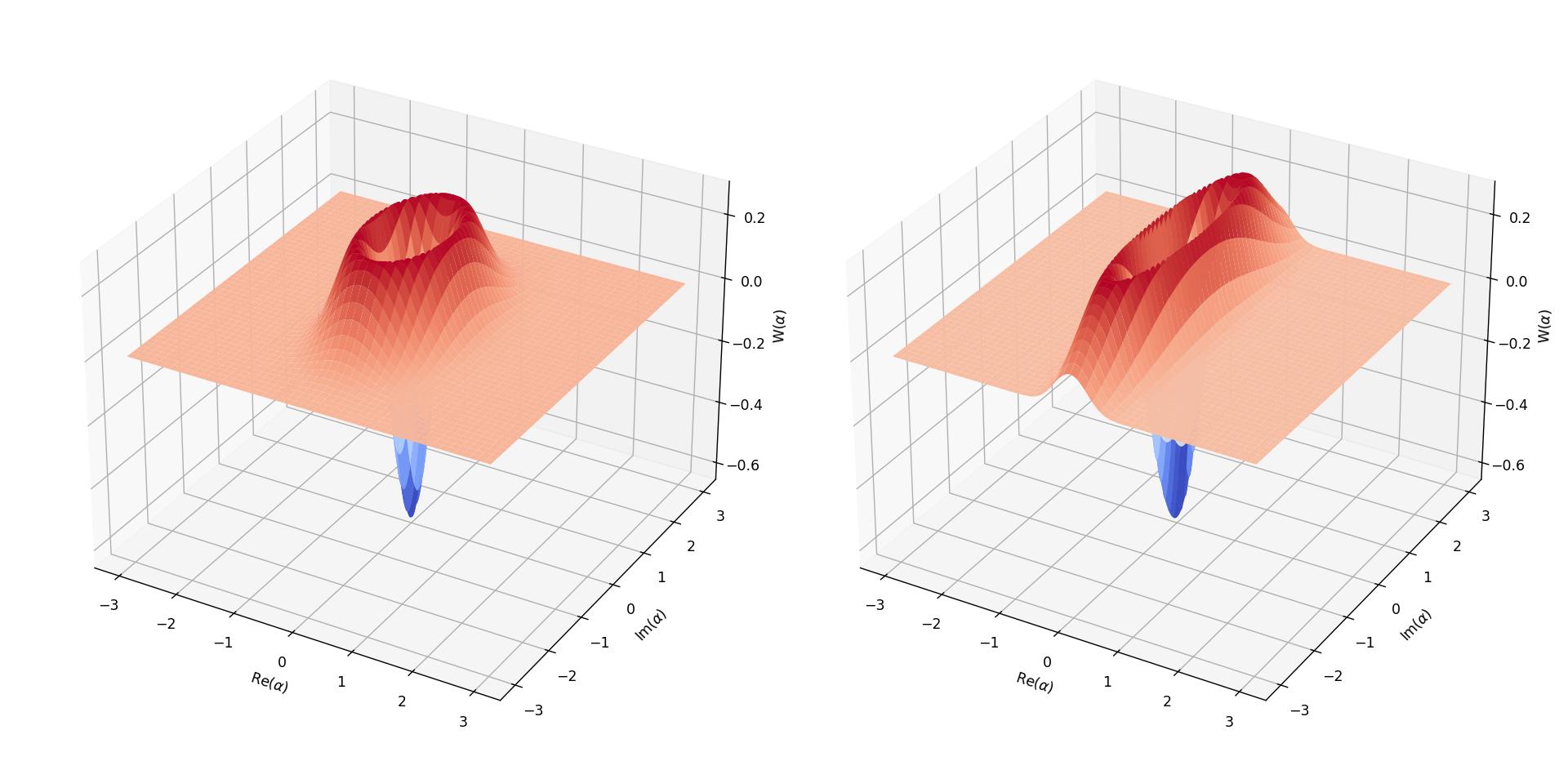
For a mixed state \(\rho\), the Wigner function is defined as:
\[ W(\alpha) = \frac{1}{\pi^2} \int \text{Tr}[\rho D(\xi)] e^{i \alpha^T \Omega \xi} d^2 \xi \]
Figures
Conclusion
The Wigner function provides a robust framework for analyzing quantum states in phase space. Its utility spans from foundational descriptions to practical implementations in quantum information science. Two-mode squeezed states, as explored in this study, underscore the potential of Wigner analysis in describing entanglement.
Study on High Energy Interactions Using Nuclear Emulsion Technique
Abhinaba Pahari
Department of Physics, Jadavpur University
Introduction
Evolution of nuclear radiation detection techniques has been crucial in uncovering the mysteries of atomic nuclei. Nuclear emulsion track detectors are sophisticated tools developed to detect charged particles.
Photographic emulsions played a role in particle physics as early as H. Becquerel's discovery of natural radioactivity. After significant advancements post-WWII, nuclear emulsions have been utilized for international collaborations and major discoveries, such as pions and other elementary particles.
Physical Characteristics of Nuclear Photographic Emulsion
- Composed of silver halide, gelatin, and plasticizer (e.g., glycerine).
- Tracks form as ionizing particles interact with emulsion, leaving visible traces after development.
- Key properties include grain size, gelatin functionality, and adhesion to glass supports.
| Element | Atomic Number | Atomic Weight | Atoms per cm³ of Halide |
|---|---|---|---|
| Silver (Ag) | 47 | 107.88 | 2.071 × 10²² |
| Bromine (Br) | 35 | 79.916 | 2.06 × 10²² |
Experimental Data
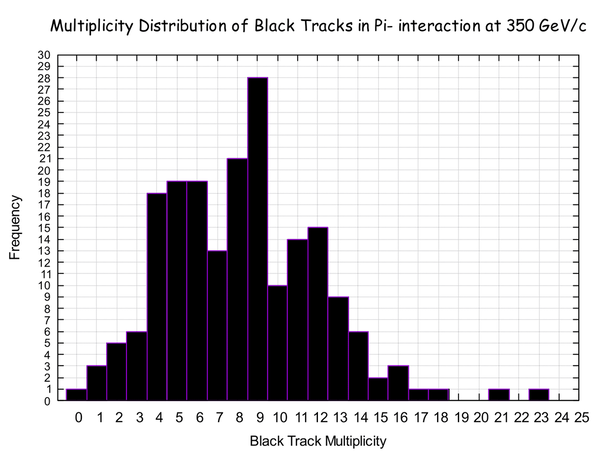
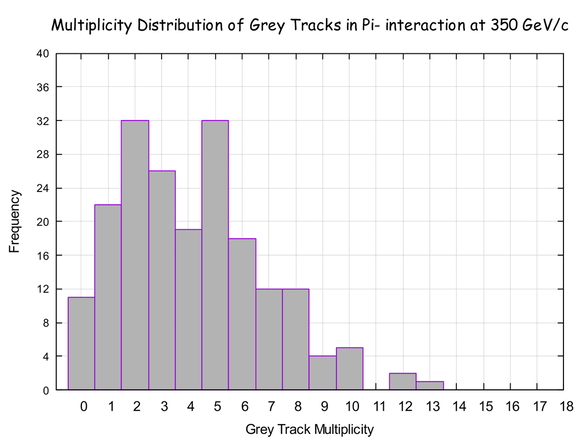
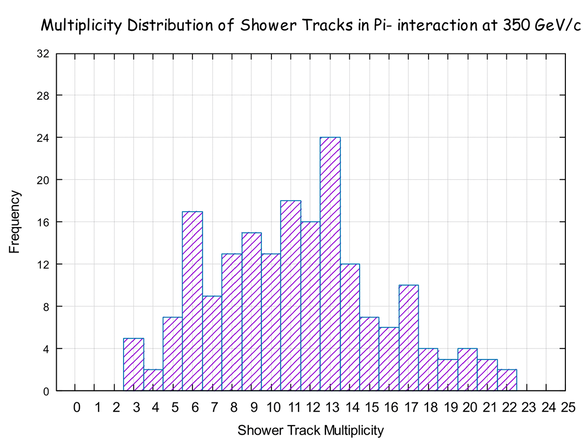
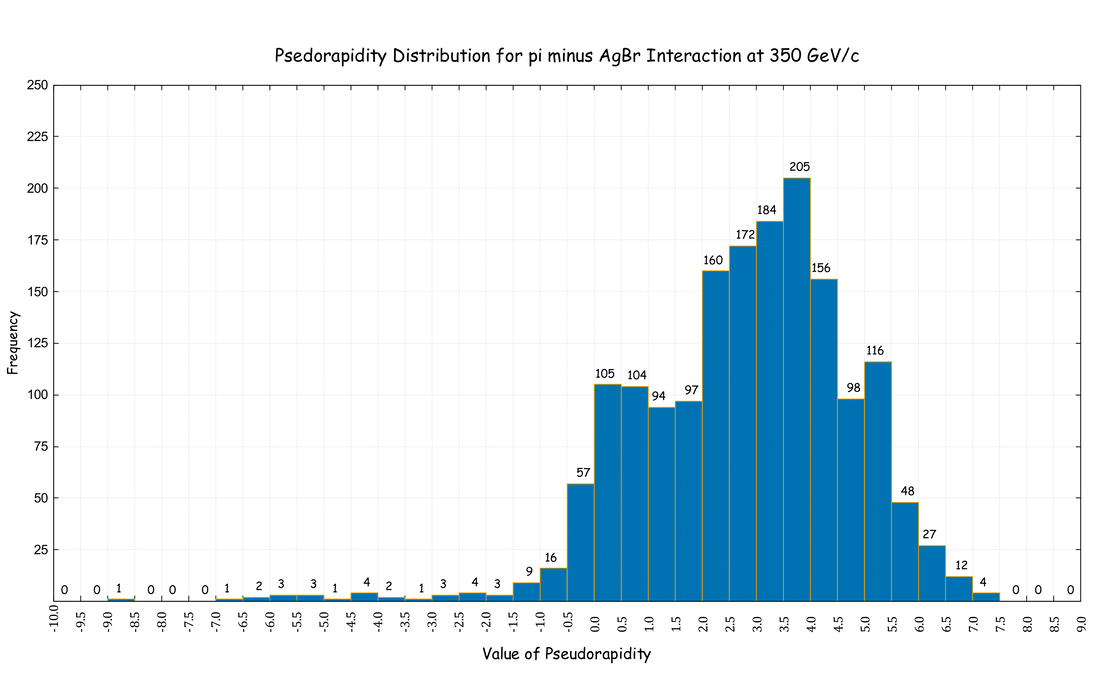
The experiment analyzed π− particle interactions at 350 GeV/c using Ilford G5 emulsions. Data was processed to extract multiplicity and pseudorapidity distributions.
Figures
Results
- Black Track Multiplicity: Gaussian distribution with mean = 8.24, most probable value = 9.
- Shower Track Multiplicity: Mean = 11.24, most probable value = 13.
- Pseudorapidity: Gaussian centered at 0. Mean = 2.69, most probable value ≈ 0.025.
Simulations using Scalable Quantum Circuit Architecture
This Project is not owned by me. All the credits of this section goes to the authors of this paper. I added this project because I studied it and it was quite helpful during my masters project.
Introduction
Simulating Hamiltonians is one of the primary goals of quantum computing, leveraging the unique capabilities of quantum systems to explore complex physical phenomena. Hamiltonians, which represent the energy of a system, are often expressed in terms of Pauli strings for quantum circuits. These Pauli strings provide an orthogonal basis for constructing operators in quantum mechanics, enabling the implementation of unitary evolution.
Objective
The objective of this research is to design scalable quantum circuits capable of implementing the exponential of Pauli strings. This enables Hamiltonian simulations on quantum hardware with low connectivity. The circuits are optimized to minimize errors and ensure scalability for large quantum systems, accommodating both time-independent and time-dependent Hamiltonians.
Quantum Circuit Design
Core Design Principles
- Pauli Strings: Linear combinations of Pauli matrices \(I, X, Y, Z\), which form a basis for representing Hamiltonians.
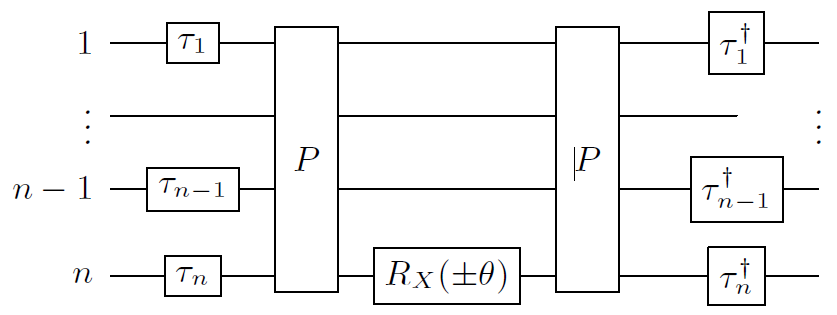
- Permutation Similarity: A novel approach to transform between Pauli strings using permutation matrices represented by CNOT gates.
- Exponential Representation: Efficient circuits for \(\exp(i\theta \sigma)\), where \(\sigma\) is a Pauli string, are constructed using Hadamard, rotation, and CNOT gates.
Implementation
The circuits are designed to handle n-qubit systems, utilizing scalable gate configurations. The design focuses on reusing elements from smaller systems to build larger circuits, ensuring compatibility with quantum hardware constraints.
Applications
Hamiltonian Simulation
The proposed circuits are applied to simulate various Hamiltonians, including:
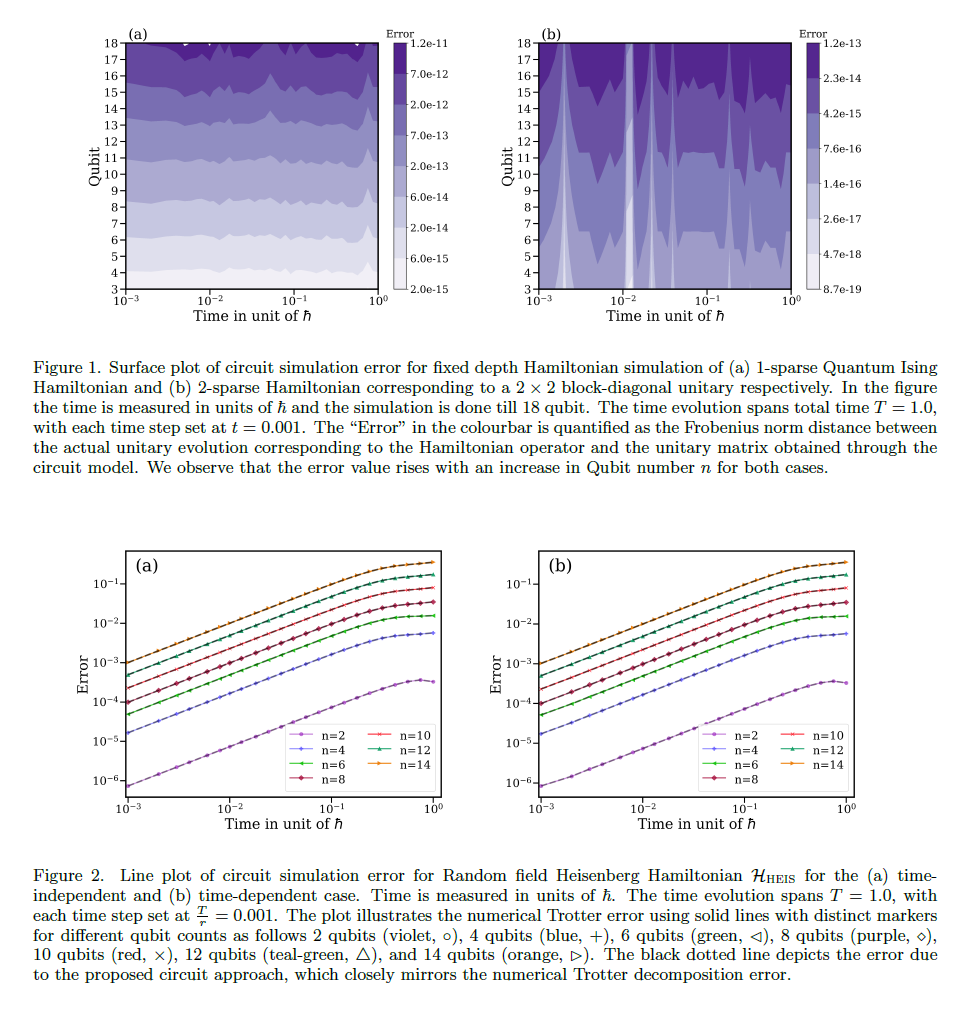
- Ising Hamiltonian: Models interactions between spins in a magnetic field, expressed as \(H = \sum J Z_i Z_{i+1} + h X_i\).
- Heisenberg Hamiltonian: Captures spin-spin interactions with terms.
- Random Field Hamiltonians: Incorporates randomness in coefficients, simulating disordered systems.
The Suzuki-Trotter approximation is employed to implement time evolution, dividing complex operations into simpler steps with controllable errors.
Noise Analysis
Impact of Noise
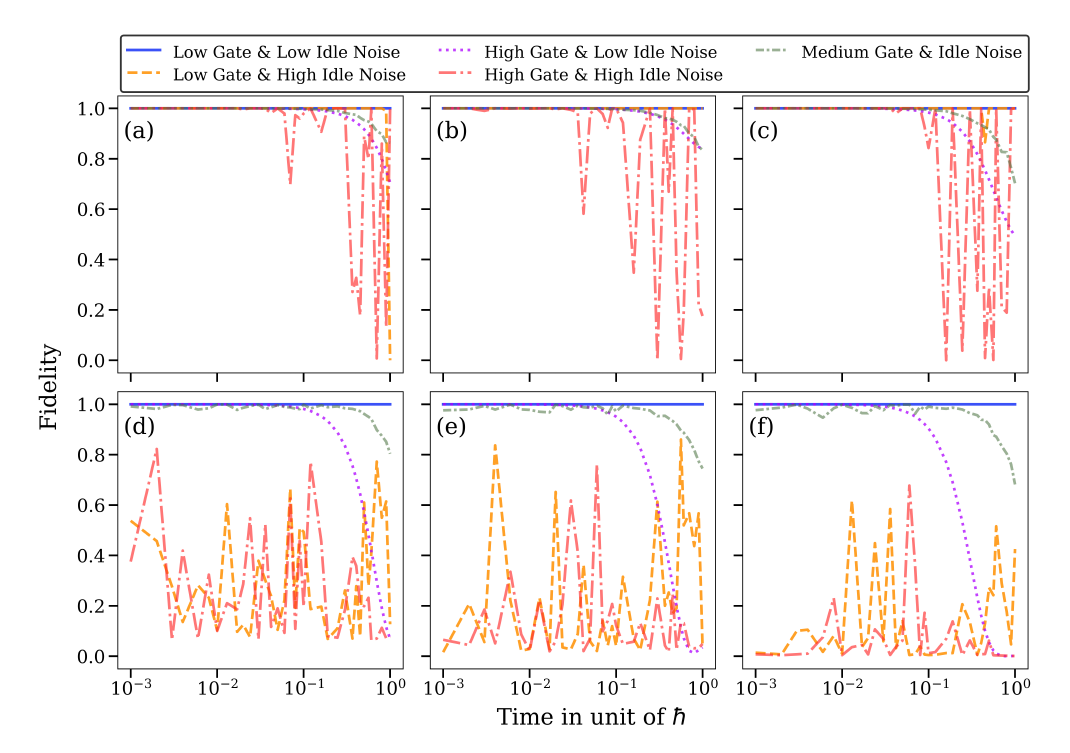
The performance of quantum circuits is evaluated under various noise models, including:
- Gate Errors: Errors arising from imperfect implementation of quantum gates, such as bit-flip and phase-flip errors.
- Idle Errors: Errors due to qubit decoherence during idle periods, modeled by amplitude damping and phase damping.
Findings
Fidelity, defined as the overlap between ideal and noisy outputs, is used to measure circuit robustness. Simulations show that fidelity remains above 0.8 for noise strengths \(p < 10^{-3}\).
Conclusion
Key Contributions
This study presents scalable and efficient quantum circuits for implementing the exponential of Pauli strings. The circuits are suitable for low-connectivity quantum hardware and robust against noise.
Future Work
Future research will focus on optimizing circuit depth for complex Hamiltonians, exploring advanced noise mitigation techniques, and implementing higher-order Trotter decompositions for improved accuracy.
Quantum Description of Electron Diffraction Through Single Slit
Authors: Abhinaba Pahari, Arnab Satpati, Sandipan Hazra
Institution: Indian Institute of Technology Kharagpur, Department of Physics
Date: 30/11/2023
Abstract
This study investigates electron diffraction through a single slit, solving the Time Independent Schrödinger Equation (TISE) in different regions of diffraction. Numerical results and intensity distribution plots validate the theoretical approach. Comparisons with contemporary theories are also discussed.
Introduction
The phenomenon of diffraction, where light spreads into alternating bright and dark regions after passing through a narrow aperture, is well-known. Classical particles do not exhibit this behavior, but electrons demonstrate wave-particle duality, leading to diffraction patterns. This work explores this peculiar property of electrons using quantum mechanics.
Theory
Electron diffraction is governed by the Time Independent Schrödinger Equation:
\[-\frac{\hbar^2}{2m} \nabla^2 \psi(x, y, z) + V(x, y, z)\psi = E\psi(x, y, z)\]
The slit is placed perpendicular to the \(x\)-axis at \(x = 0\) and extends from \(y = 0\) to \(y = a\). The problem is divided into three regions: incident, slit, and diffraction. The wavefunction at the screen is obtained by solving the TISE and applying boundary conditions.
Wavefunction Inside the Slit
For an incident wavefunction: $$\psi_i(x, y) = A_0 e^{ikx}$$
The TISE inside the slit becomes: $$\nabla^2 \psi_s = -\frac{2mE}{\hbar^2} \psi_s$$
Using separation of variables, the solution is: $$\psi_s(x, y) = \sum_{n=0}^{\infty} A_n \sin\left(\frac{(2n+1)\pi y}{a}\right) e^{i\sqrt{\frac{2mE}{\hbar^2} - \frac{n^2 \pi^2}{a^2}} x}$$
Wavefunction on the Screen
In the diffraction region, the potential \(V(x, y) = 0\). The wavefunction is: $$\psi_d(x, y) = \int_{-\infty}^\infty A(k_y) e^{i\left(x\sqrt{\frac{2mE}{\hbar^2} - k_y^2} + k_y y\right)} dk_y$$
At \(x = b\), the wavefunction on the screen is: $$\psi_{\text{screen}}(y) = \frac{4aA_0}{\pi} \int_{-\infty}^\infty e^{ib\sqrt{\frac{2mE}{\hbar^2} - r^2} + iry} \sum_{n=0}^\infty \frac{1 + e^{-iar}}{((2n+1)\pi)^2 - a^2r^2} dr$$
Numerical Results
Using Python, the intensity distribution \(I \propto |\psi_{\text{screen}}|^2\) was computed for varying slit widths and electron energies. The results show:
- Maxima occur at \(y = a/2\).
- Central maxima width decreases as slit width increases.
- Central maxima broadens with lower electron energy.
Conclusion
The study successfully demonstrates electron diffraction through a single slit, emphasizing wave-particle duality. Non-relativistic treatment yields accurate results for low-energy electrons. Future work may extend to relativistic cases for high-energy scenarios.
References
- Quantum Mechanics: Concepts and Applications by Nouredine Zettili
- Quantum Theory of Light Diffraction by Yan Wang, Jing-Wu Li
- Quantum Mechanics by David J. Griffiths
- Single-Slit Electron Diffraction with Aharonov-Bohm Phase by P. Khatua et al.
- Fundamentals of Optics by Jenkins and White
IoT-Based Real-Time Air Quality Monitoring System
Abhinaba Pahari, Arnab Satpati, Sanjay Dey, Arpon Roy
Department of Physics, IIT Kharagpur
Abstract
Air pollution is a critical health and environmental concern, particularly in urban and industrial areas. This project presents an IoT-based air quality monitoring system powered by the ESP8266 microcontroller. Using the MQ135 gas sensor for harmful gases and the DHT11 sensor for temperature and humidity, it provides continuous, accessible, and accurate air quality data.
Introduction
Air pollution significantly impacts public health, necessitating real-time monitoring. Traditional systems are expensive and limited in scope. This project employs IoT technology to design a scalable and low-cost solution suitable for diverse environments.
Motivation
- Rising air pollution levels.
- Health benefits through real-time alerts.
- Scalability for wide applications.
- Educational value in IoT and environmental science.
Objective
- Accurate measurement of air quality using the MQ135 sensor.
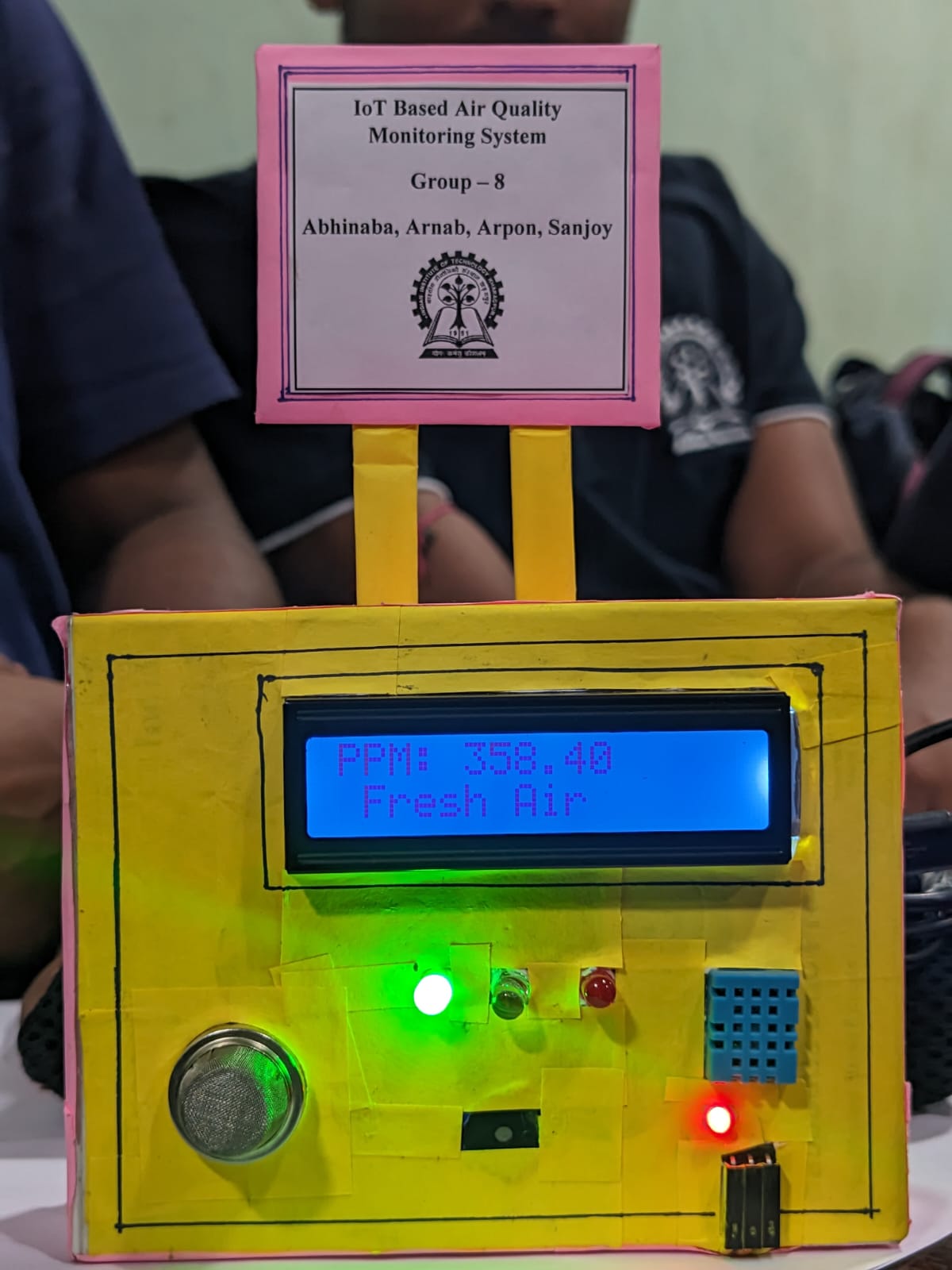
- Real-time alerts with LEDs and buzzer for unsafe levels.
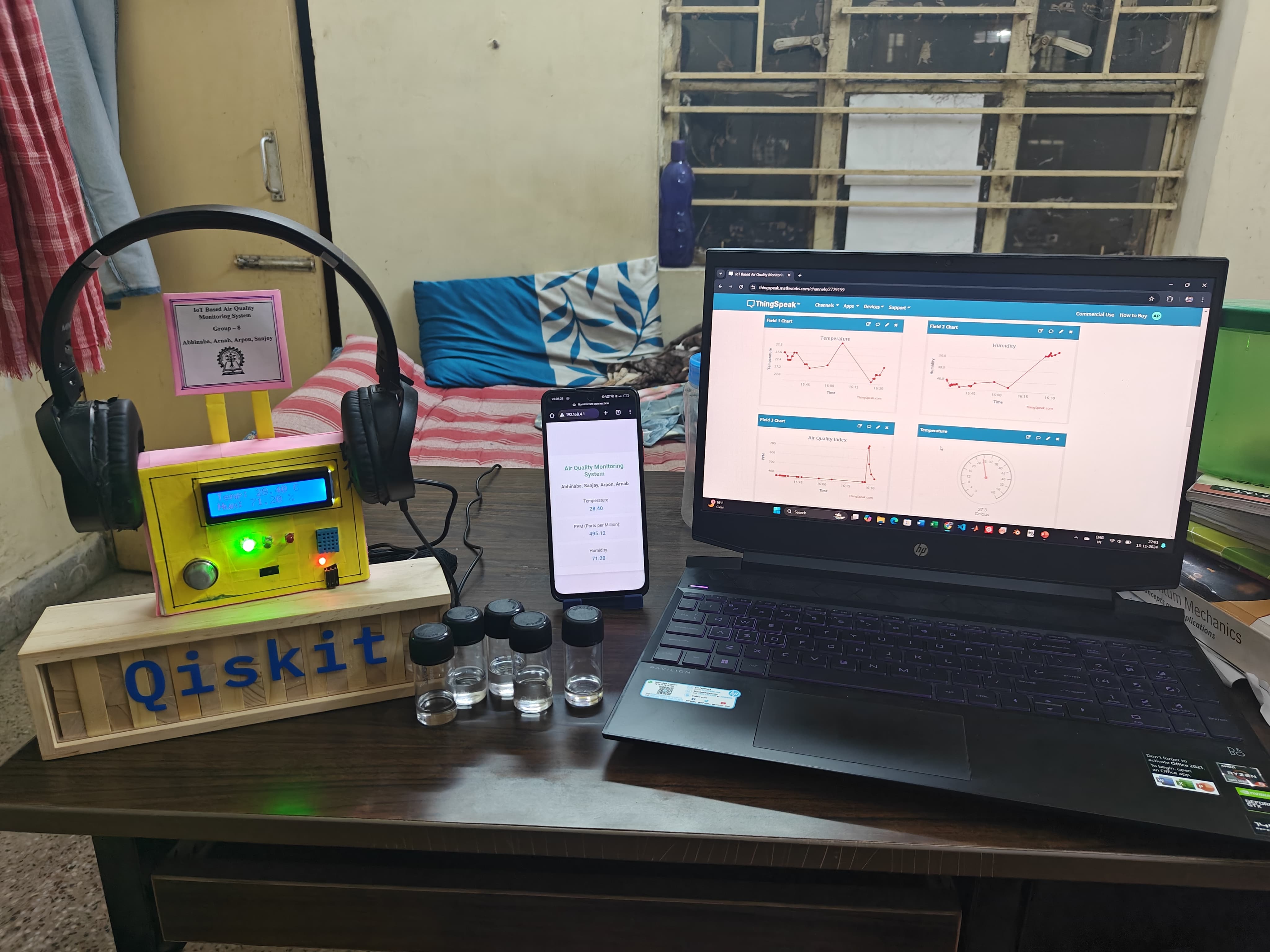
- Remote monitoring and visualization via the ThingSpeak app.
Methodology
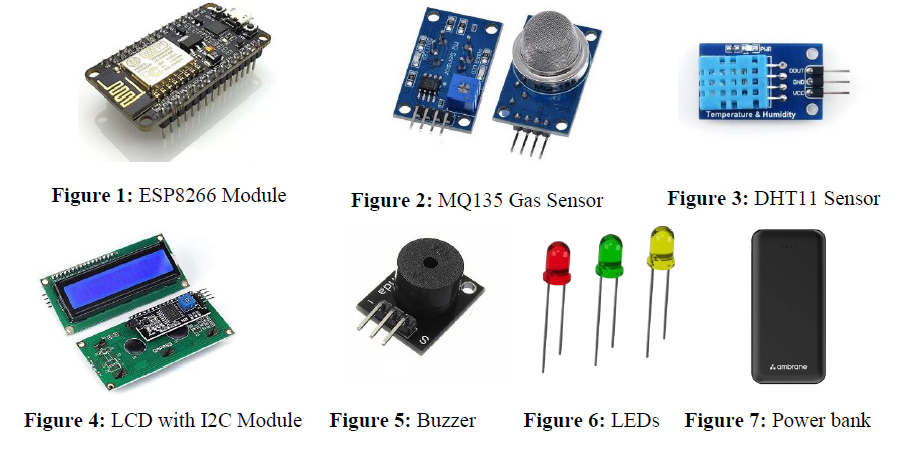
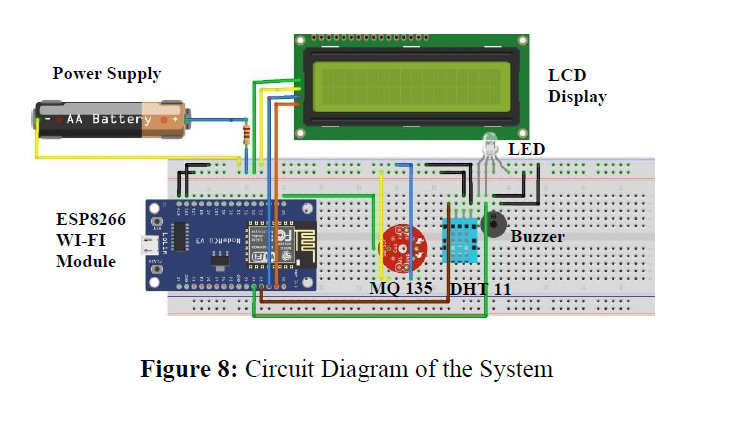
The system is based on an ESP8266 Wi-Fi module integrated with MQ135 and DHT11 sensors. Data is collected and transmitted to ThingSpeak for real-time monitoring. LEDs and a buzzer provide instant alerts for unsafe air quality levels.
Figures
Results
Figures: Variations of temperature, humidity, and air quality index over time were documented.
Discussion
- Effective IoT-based monitoring demonstrated scalability and cost-effectiveness.
- Identified limitations and proposed hardware upgrades for future projects.
Acknowledgment
Gratitude expressed to mentors, the Physics Department of IIT Kharagpur, and contributors for their guidance and support.